
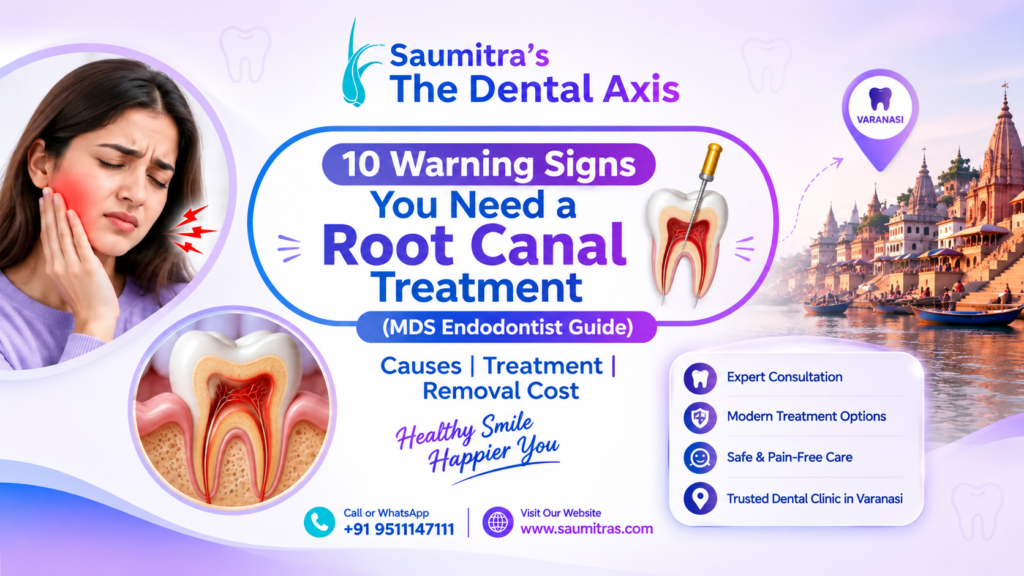
10 Warning Signs You Need a Root Canal Treatment (MDS Endodontist Guide)
A toothache that keeps coming back is your body asking for attention. Many patients in Varanasi wait weeks, hoping the pain will settle, until a tooth that was easy to save becomes harder to treat.
This guide explains the most common signs you need a root canal, drawn from the clinical experience of an MDS endodontist (a dentist with post-graduate specialisation in root canal treatment). You will learn what each symptom usually means and how urgent it is. Treat it as a guide, not a diagnosis: only an examination and an X-ray can confirm whether you need root canal treatment (RCT).
What Is a Root Canal, and Why Does the Pulp Get Infected?
Root canal treatment removes infected or inflamed nerve tissue from inside a tooth, disinfects the canals and seals them, so you keep your natural tooth instead of losing it.
Understanding the Tooth Pulp
Under the enamel and dentine sits a soft core called the pulp. It holds nerves and blood vessels and runs down narrow channels inside the roots, called root canals.
How a Tooth Pulp Infection Starts
- Deep decay that reaches close to the nerve
- Cracks or chips that let bacteria in
- Repeated dental work on the same tooth
- An injury to the tooth, even one with no visible damage
An inflamed or infected pulp cannot heal on its own. Left untreated, the infection can spread to the bone and form an abscess. Spotting tooth pulp infection signs early keeps treatment simple.
10 Warning Signs You Need a Root Canal
These are the ten root canal symptoms our team sees most often. One sign alone may have another cause, but two or more together, or a sign that keeps returning, is a strong reason to get checked.
1. A Toothache That Will Not Go Away
Persistent pain is the most common of all the signs you need a root canal. It may be a dull ache deep in the tooth or jaw, or a sharp pain that fades and returns. Painkillers may mask it for a few hours, but the cause remains.
2. Sensitivity to Hot or Cold That Lingers
Brief sensitivity to cold is common. The warning sign is pain that lingers for 30 seconds or more after the hot or cold item is gone. This usually means the nerve itself is inflamed.
Ordinary sensitivity vs. root canal pain
- Ordinary sensitivity: sharp, short, stops when the trigger is removed
- Possible nerve problem: throbbing pain that continues long after eating or drinking
3. Pain When You Bite or Chew
If one tooth hurts when you bite down or tap it lightly, the infection may have reached the tissue around the root tip. Pain on biting is one of the signs you need a root canal that should be checked soon.
4. Pain That Wakes You Up at Night
Pain that starts on its own, or worsens when you lie down, is a classic sign of irreversible pulpitis. Among the signs you need a root canal, this one rarely settles without treatment.
5. Swollen or Tender Gums Near One Tooth
Puffy, tender or darker gums around a single tooth can point to infection below the gum line. The swelling may come and go.
6. A Pimple or Boil on the Gum
A small bump that releases pus, often with a bad taste, is a gum boil (sinus tract), the infection’s drainage channel. It may stop hurting once it drains, but the infection is still active. This is one of the clearest tooth pulp infection signs.
7. A Darkening or Discoloured Tooth
A tooth turning grey or brown, often months after an injury, may have a damaged or dead nerve. Not every discoloured tooth needs RCT, so an X-ray and pulp test are needed.
8. Deep Decay or a Large, Old Filling
Deep decay is one of the quieter signs you need a root canal: once a cavity nears the pulp, a filling is often not enough.
9. A Cracked or Chipped Tooth
Biting something hard, grinding or a fall can crack a tooth, and even a fine crack lets bacteria reach the pulp. Pain when releasing your bite is a common clue.
10. A Loose Tooth or Swelling in the Face or Jaw
An adult tooth that feels loose without gum disease, or swelling that spreads to the cheek or jaw, can mean the infection has reached the bone. These are serious signs you need a root canal or other urgent care (see the emergency section below).
What If the Pain Suddenly Stops?
A toothache that disappears after days of severe pain is not always good news. The nerve may have died while the infection continues silently. Routine X-rays often catch hidden signs you need a root canal before pain starts.
Root Canal Symptoms at a Glance
This table matches common signs you need a root canal with how soon to act. It is a general guide; an examination is still needed.
| Symptom | What it may indicate | How soon to see a dentist |
| Lingering sensitivity to hot or cold | Inflamed pulp (pulpitis) | Within a week |
| Persistent or recurring toothache | Pulp inflammation or infection | Within 2–3 days |
| Pain on biting or chewing | Infection around the root tip | Within 2–3 days |
| Night pain or spontaneous pain | Irreversible pulpitis | Within 24–48 hours |
| Gum boil or pus | Abscess draining through the gum | Within 24–48 hours |
| Darkened tooth | Damaged or dead nerve | Within 1–2 weeks |
| Facial swelling, fever, difficulty swallowing | Spreading infection | Same day; hospital emergency if breathing or swallowing is affected |
When Is It a Dental Emergency?
Most signs you need a root canal call for a prompt appointment, not emergency care. Seek care the same day if you have:
- Growing swelling in the face, cheek, jaw or under the chin
- Fever along with tooth pain or swelling
- Severe pain that painkillers do not control
- A tooth knocked loose or broken after an injury
Go to the nearest hospital emergency department immediately if swelling makes it hard to breathe, swallow or open your mouth.
During clinic hours (Tuesday to Sunday, 10 AM to 8 PM), call Saumitra’s The Dental Axis on +91 95111 47111 and mention that it is urgent.
When Do You Need RCT, and What Does Treatment Involve?
When do you need RCT? When the pulp is irreversibly inflamed or infected but the tooth is strong enough to restore. If the tooth is too broken or the root is fractured, extraction and a replacement such as a dental implant may be better. Your endodontist will explain both options honestly.
Step-by-Step: The Root Canal Procedure
- Diagnosis: examination, pulp testing and an X-ray.
- Local anaesthesia: the area is numbed; most patients find it similar to a filling.
- Isolation: a rubber dam keeps the tooth clean and dry.
- Cleaning and shaping: infected pulp is removed and the canals are disinfected.
- Filling the canals: canals are sealed with gutta-percha.
- Restoring the tooth: a filling is placed, and back teeth usually need a crown.
Single Visit or Multiple Visits?
Many cases can be completed in a single visit at our clinic. Teeth with severe infection or complex canals may need two or more appointments. Learn more on our root canal treatment page.
Why Choose Saumitra’s The Dental Axis for Root Canal Treatment in Varanasi
If you have noticed the signs you need a root canal, specialist training makes a real difference to comfort and results.
- Specialist-led care: treatment by an MDS in Conservative Dentistry & Endodontics
- Tooth-saving approach: your natural tooth comes first whenever that is sensible
- No unnecessary treatment: a clear explanation of what your X-ray shows and why
- Comfort-focused: effective anaesthesia and a calm approach for anxious patients
- Complete care: RCT and crowns, plus teeth cleaning, cosmetic dentistry and children’s dentistry
- Convenient location: Chetmani Crossing, Bhelupur, easy to reach from Durgakund, Lanka and Assi
Meet Your Endodontist: Dr. Vijay Parashar
Dr. Vijay Parashar is the Lead Dental Surgeon and Founder of Saumitra’s The Dental Axis.
- BDS: King George’s Medical University (KGMU), Lucknow
- MDS: Conservative Dentistry & Endodontics, IMS, Banaras Hindu University
- Former Senior Resident: Conservative Dentistry & Endodontics, IMS BHU
- Experience: 10+ years of clinical practice
- Focus areas: root canal treatment, endodontic surgery, implants, full-mouth rehabilitation and cosmetic dentistry
About This Guide (Expertise and Trust)
This article was prepared by the clinical team at Saumitra’s The Dental Axis from the everyday diagnostic experience of an MDS endodontist. It is consistent with patient guidance from the American Association of Endodontists and the NHS guide to root canal treatment.
- Clinically reviewed by: Dr. Vijay Parashar, BDS, MDS (Conservative Dentistry & Endodontics)
- Purpose: patient education; it does not replace an in-person examination
- Our promise: we confirm the signs you need a root canal with an examination and X-ray before recommending treatment
Frequently Asked Questions
1. What are the first signs you need a root canal?
Usually, sensitivity to hot or cold that lingers, and a toothache that keeps returning. Pain while chewing often follows.
2. Can I need a root canal without any pain?
Yes. A painless gum boil or a darkening tooth can be silent signs you need a root canal, sometimes visible only on an X-ray.
3. Is root canal treatment painful?
It is done under local anaesthesia, so most patients feel pressure rather than pain. Mild tenderness for a few days afterwards is normal.
4. How long does a root canal take?
A straightforward case may take about 45 to 90 minutes. Complex or severely infected teeth may need more than one visit.
5. Will I need a crown after RCT?
Molars and premolars usually need a crown because they take heavy chewing forces. Front teeth may need only a filling.
6. How long does a root-canal-treated tooth last?
With a good seal, a crown where needed and regular check-ups, a treated tooth can last many years, often a lifetime.
7. Can children need a root canal?
Yes. Baby teeth with deep decay may need a pulp treatment. Our pediatric dentistry team can advise.
8. How do I know whether I need RCT or just a filling?
If decay has not reached the nerve and pain stops quickly, a filling may be enough. Lingering pain, night pain or swelling are signs you need a root canal; an X-ray confirms it.
Conclusion
Lingering sensitivity, pain on chewing, night pain, a gum boil, a darkening tooth and facial swelling are the key signs you need a root canal. Acting early usually means a simpler visit and a better chance of saving your natural tooth. If you notice any of these root canal symptoms, do not wait for the pain to become unbearable; have the tooth examined by a specialist.
Book Your Root Canal Consultation in Varanasi
Noticed any of the signs you need a root canal? Let our endodontist examine the tooth and explain your options clearly, with no pressure.
Saumitra’s The Dental Axis
- Address: B-27/86, M-18, Chetmani Crossing, Bhelupur, Varanasi – 221010
- Call: +91 95111 47111
- WhatsApp: Chat with us
- Clinic hours: Tuesday to Sunday, 10 AM – 8 PM (closed Mondays)
- Book online: Request an appointment